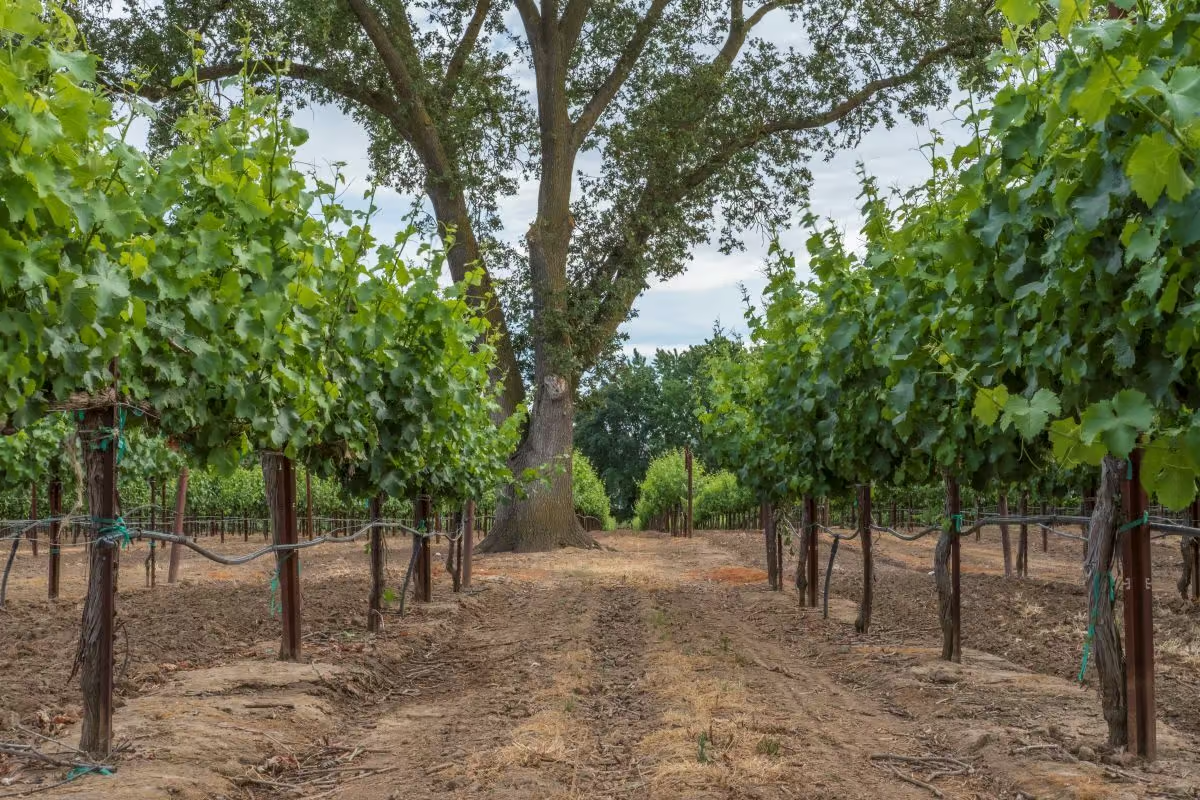
If you farm anywhere around California right now, you really don't need a report to tell you what's happening in the wine grape business. You can see it driving down almost any country road. Vineyards that were farmed for decades are sitting untouched, piles of pulled vines are waiting to be processed, and ground that most of us always knew as vineyards is being prepared for something else.
For growers, this has been one of the hardest market corrections we've seen in a long time. The problem is not that California suddenly forgot how to grow good grapes. In fact, recent vintages have produced some excellent fruit. The problem is that more grapes and wine are available than the market wants to buy at prices that allow growers to keep farming profitably.
That imbalance has forced a lot of difficult decisions. Some growers are cutting costs and trying to ride it out. Others are changing varieties or diversifying into different crops. And more and more are making the decision nobody really wants to make: pulling the vineyard.
California Has Already Lost Tens of Thousands of Vineyard Acres
The acreage numbers show how quickly this correction is happening. The USDA's 2024 acreage report estimated California still had 590,000 acres of wine grapes, including 550,000 bearing acres. More recent industry mapping, however, identified only 477,475 acres of standing wine grapes as of August 2025, along with 38,134 acres removed between October 2024 and August 2025. That standing-acreage figure includes bearing, non-bearing, mothballed, and abandoned vineyards that were still physically in the ground.
USDA California Grape Acreage Report
California Winegrape Vineyard Mapping and Removal Data
For a region like Lodi, grapes are not just another crop. They've shaped the region's identity and economy for generations, which makes seeing this much acreage disappear especially difficult. The same mapping project put the Lodi AVA at about 82,303 acres of standing wine grapes as of August 2025, showing just how significant the ongoing adjustment is for the region.
The bigger picture is clear:
More than 38,000 acres were identified as removed statewide in less than a year.
Additional vineyards remained mothballed or abandoned but had not yet been physically removed.
Lodi remains one of California's largest wine grape regions and is directly exposed to this market correction.
Acreage numbers can vary depending on whether a report counts planted, bearing, abandoned, or physically standing vineyards.
Why Is the Wine Grape Market This Bad?
The short answer is that consumer demand changed faster than vineyard acreage did.
Wine consumption has softened, wineries have been working through inventory, and growers are dealing with fewer contracts for some varieties. At the same time, farming costs for labor, fuel, water, equipment, insurance, and financing have remained high. Vineyards cannot respond to a changing market overnight. A winery can reduce purchases fairly quickly, but a grower with a mature vineyard cannot simply turn those vines into another crop the following season without spending significant money to remove the vineyard and redevelop the ground.
That lag is one reason the oversupply has lasted as long as it has. Growers can do everything right agronomically and still lose money if there's no market for the crop.
A few factors have been working against growers at the same time:
Declining or changing consumer wine demand
Excess wine inventories
Fewer grape contracts
Competition from imported wine
Rising vineyard farming costs
Reduced demand for certain varieties
Growers producing fruit without guaranteed buyers
The result is a market where even good grapes can be difficult to sell.
Lodi Is Feeling the Correction More Than Most Regions
Lodi has always been a major wine grape region. We grow a tremendous amount of fruit and have historically supplied many of the country's larger wine programs. When those companies reduce purchases, growers here feel it quickly.
The region also has significant acreage of Zinfandel, Cabernet Sauvignon, Chardonnay, and other varieties tied to larger-volume wine programs. That makes Lodi particularly sensitive when national wine consumption slows or major wineries change their sourcing strategies.
The difficult part is that many of these are good vineyards. Some are old vineyards with generations of history behind them. They're not necessarily being removed because they stopped producing quality grapes. They're coming out because the economics no longer support farming them.
That's an important distinction. A grower can farm a vineyard correctly, produce a good crop, and still find themselves without a market that covers the cost of producing it.
Pulling a Vineyard Has Become More Complicated Too
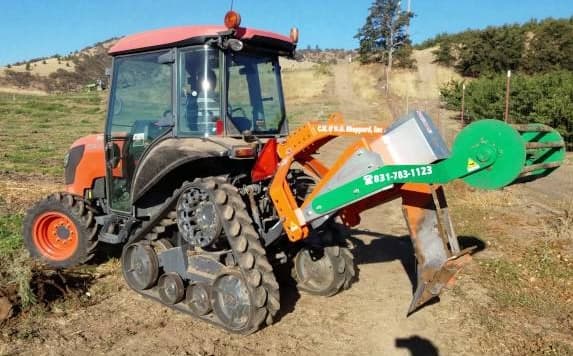
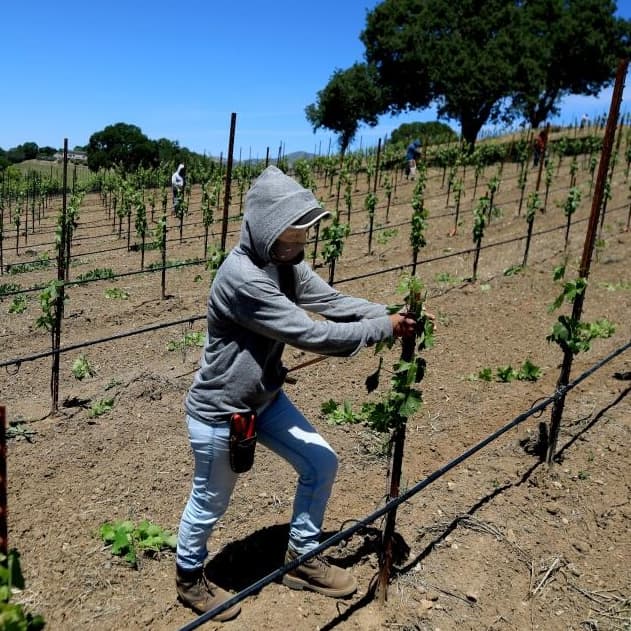
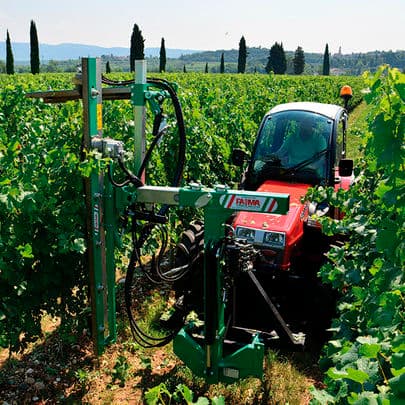
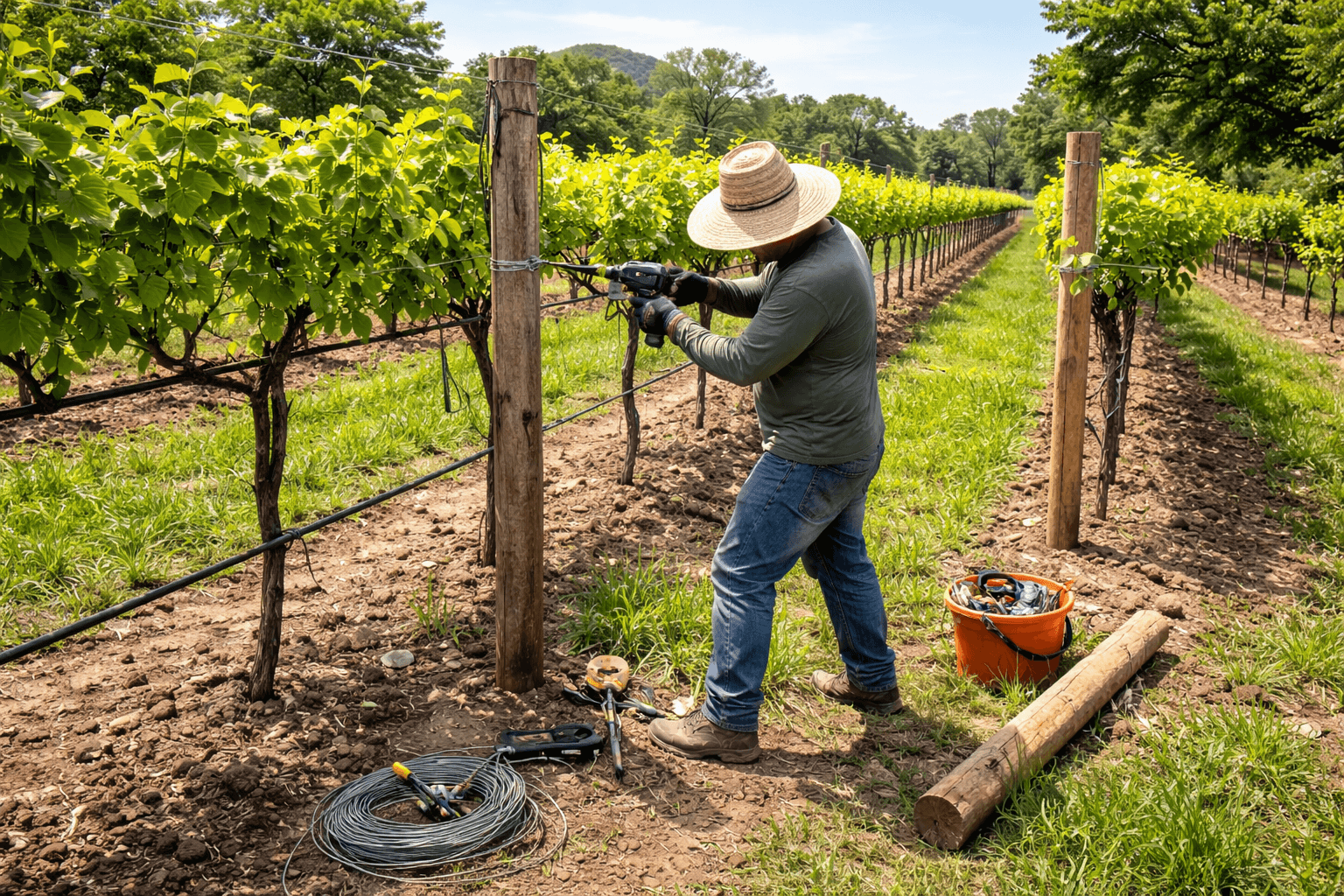
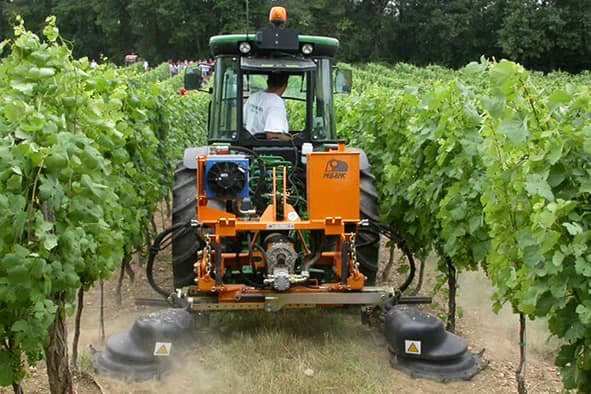
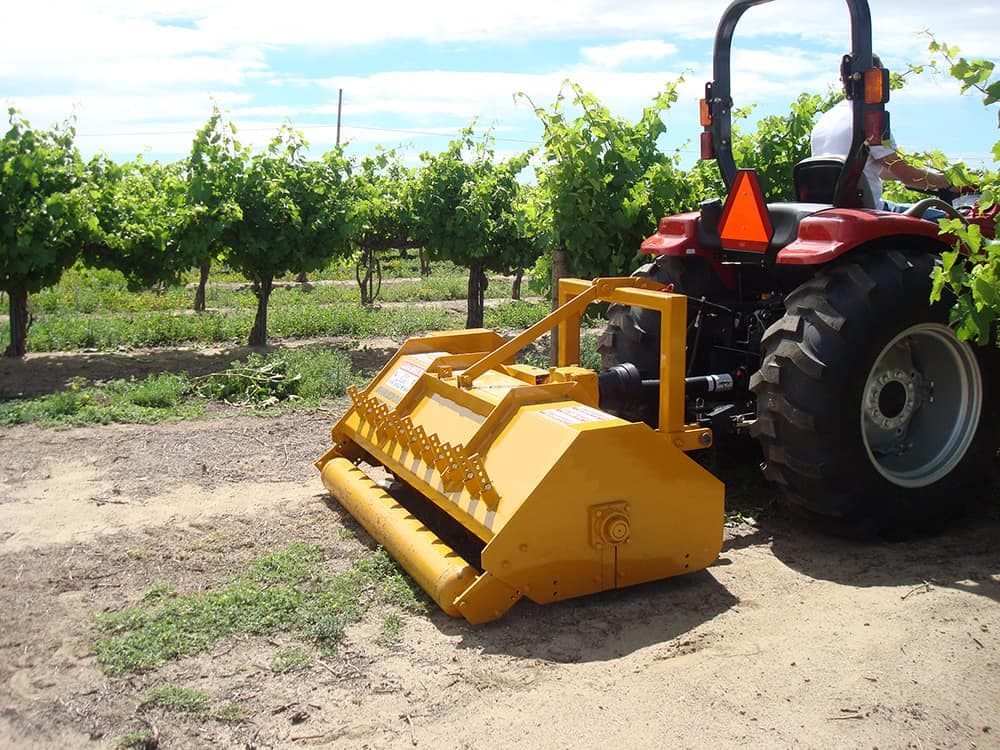
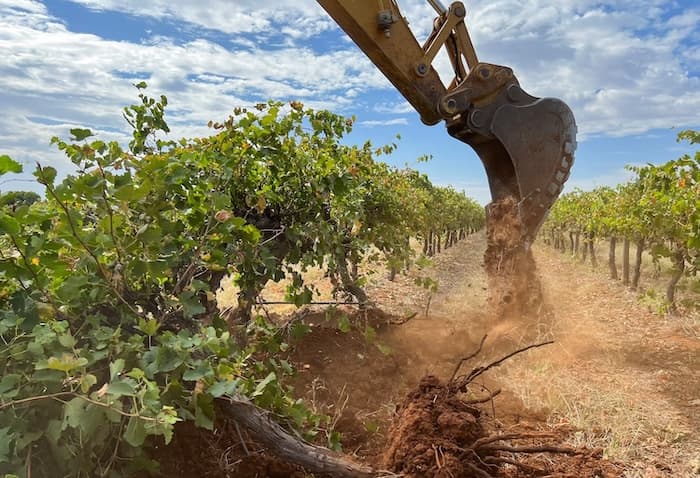
Deciding to remove a vineyard is only the beginning. The actual removal can involve vines, roots, trellis systems, wire, irrigation infrastructure, grinding or chipping, hauling, ripping, leveling, and whatever work is necessary to prepare the ground for its next use.
Disposal has changed as well. As of January 1, 2025, vineyard removals are among the agricultural materials prohibited from routine open burning in the San Joaquin Valley, with only limited exceptions remaining. That makes planning for chipping, shredding, incorporation, or other approved disposal methods an important part of the removal process.
San Joaquin Valley Agricultural Burning Requirements
A full vineyard transition may involve:
Vine and root removal
Trellis and wire removal
Grinding or chipping
Biomass hauling or beneficial reuse
Deep ripping
Discing and leveling
Irrigation removal or modification
Soil preparation
Establishment of the next crop
If you're replacing the vineyard with another permanent crop, those expenses can add up quickly. That's why I would look at available assistance before starting any removal project.
There Is Vineyard Removal Assistance Available in the San Joaquin Valley
One program growers should look at before removing vines is the San Joaquin Valley Air Pollution Control District Ag Burn Alternatives Grant Program.
The program provides incentives to commercial agricultural operations within District boundaries to process material from orchard and vineyard removals as an alternative to open burning. Eligible practices include whole-vineyard recycling and soil incorporation, on-site agricultural land application, certain off-site beneficial reuse, and limited air-curtain burning for eligible diseased material or material containing embedded wire.
Ag Burn Alternatives Grant Program and Application
Growers need to understand several requirements. The property must remain in agricultural use, only commercial agricultural operations qualify, and total funding is limited to 100 acres per entity per calendar year. The District processes complete applications on a first-come, first-served basis while funding is available.
Most importantly, apply before doing the work. The District's process calls for the grower to submit an application, complete a pre-inspection, and receive a voucher before completing the project. The grower then completes and pays for the project, submits the reimbursement claim, and goes through a post-inspection.
If you're considering pulling vines, this is one program I'd check before equipment moves onto the ranch.
USDA Assistance Exists, but It Isn't a Market-Driven Vineyard Buyout
This distinction matters because I've seen assistance programs get mixed up.
USDA's Tree Assistance Program, or TAP, can help eligible growers rehabilitate or replant vines damaged or destroyed by qualifying natural disasters. For 2026, USDA says producers can qualify when eligible losses exceed normal mortality, and TAP generally provides cost-share assistance of up to 65% of actual eligible replanting or rehabilitation costs, with certain limited-resource, socially disadvantaged, and beginning farmers or ranchers potentially eligible for up to 75%.
USDA Tree Assistance Program (TAP)
But TAP doesn't pay growers to remove a healthy vineyard because grape prices are low or a winery canceled a contract. It is disaster assistance for eligible tree, bush, and vine losses.
That's why growers should distinguish between:
Market-loss assistance
Disaster assistance
Vineyard-removal incentives
Environmental and air-quality programs
Redevelopment assistance
No single program covers the full cost of removing an economically unviable California wine grape vineyard. The right program depends on why the vineyard is being removed and what happened to the crop.
What Happens After the Vines Come Out?
This may be the biggest question growers are facing.
Removing vines solves the immediate problem of continuing to spend money farming a crop without a reliable buyer, but it doesn't answer what happens to the ground next. Around the Central Valley, growers are evaluating everything from other permanent crops and annual production to lower-water alternatives and simply leaving ground open while they determine what pencils out.
I don't think there is one correct replacement crop. The answer depends on the ranch, and this probably isn't the market to chase another crop just because everyone else is planting it.
Before replanting, I'd be looking closely at:
Long-term water availability
Soil type and drainage
Establishment costs
Expected market demand
Labor requirements
Harvesting infrastructure
Time until the crop produces revenue
Whether the farm already has experience with that crop
The last thing a grower wants is to spend thousands of dollars removing one oversupplied crop and immediately plant another without understanding where that market may be headed.
Imports Are Still Part of the Conversation
Imported wine has also entered the discussion among California growers.
California lawmakers introduced AB 1585, which would restrict wine produced, bottled, labeled, offered for sale, or sold in California from using an "American" or "United States" appellation unless 100% of the wine is derived from U.S.-grown grapes or other qualifying agricultural products.
California AB 1585 Wine Labeling Legislation
Regardless of what ultimately happens legislatively, the issue shows how seriously growers are looking at imports, labeling, domestic sourcing, and transparency as California works through the current imbalance.
What I Would Be Thinking About as a Grower Right Now
This is probably the hardest part because every vineyard is different. If the vineyard has a strong contract, good production, manageable costs, and a reliable buyer, pulling it because everyone else is pulling vines doesn't make sense.
On the other hand, continuing to spend money farming an uncontracted vineyard while hoping a buyer appears isn't much of a strategy either. I'd be looking at the vineyard like any other business asset. What does it cost to farm? What is the realistic revenue? How secure is the buyer? What does removal cost? What are the alternatives for the land?
Sometimes the right decision will be to keep farming. Sometimes it will be to change varieties or reduce costs and wait. Unfortunately, for some growers, the right business decision will be to pull the vines.
Final Thought
I don't think this is the end of California wine grapes, and I certainly don't think it is the end of Lodi wine.
Lodi has been growing grapes for generations, and excellent vineyards, wineries, and growers here produce wines that can compete with anyone. But the industry is going through a painful adjustment, and growers are carrying much of that burden.
The statewide removal numbers tell us the correction is already well underway. More than 38,000 acres were identified as removed between October 2024 and August 2025, while additional mothballed and abandoned vineyards remained physically standing.
The question now is what the California wine grape industry looks like after acreage, inventory, and consumer demand finally come back into balance. We probably won't know that answer for another few seasons.
For now, growers have to make decisions based on the operation in front of them, not the wine market we had five or ten years ago.
Considering Vineyard Removal or Redevelopment?
If you're evaluating vineyard removal, grinding, chipping, hauling, ripping, land preparation, irrigation changes, or redevelopment, Agnomy helps growers connect with experienced agricultural service providers who understand California agriculture.
Before starting a San Joaquin Valley removal, it's also worth checking the current Ag Burn Alternatives Grant Program to see whether your project may qualify for assistance.
Whether the next step is another vineyard, a different permanent crop, annual production, or simply preparing the ground while you decide what comes next, the goal is the same: make the transition correctly and position the ground for whatever you decide to do next.